The Pick and Shovel Poet - Pascal D'Angelo
A Collection Built Around the Life of Pascal D'Angelo
Contents: Histography | Radicalism | References
Historical Context
Italian-American immigration history is full of rich and interconnected stories of struggle, adaptation, and creativity. An important part that keeps these stories alive is poetry. Italian-American labourers used poetry to express their experiences while facing a new life in America. This section looks at how Italian-American immigrants shaped their lives with cultural and economic resilience through the poetic practices and works of Pascal D’Angelo, one of the most remembered voices in this tradition.
Italian immigration to the United States during the late 19th and early 20th centuries was fueled by economic and social hardships for southern Italians. The small village of Pascal D’Angelo, Introdacqua, found within the mountainous region of Abruzzo, was especially riddled with poverty and lacked jobs (Mattalia et al., 2021). The South’s practice of subsistence farming, which was its only means of economic and health, was destroyed as they were left behind during the rapid industrialization in North Italy. The only option remaining for many in the South was to emigrate for a better future for themselves and their families (Cannato, 2021).
Countless studies reveal the communities in the South of Italy where mass migration took place, from the center and capital Rome down to the southernmost tip in Sicilia. Whether it was because they were facing economic struggle or just for the dream of the Land of Promise, many Italians, if not most, came from these regions. This emigration of rural Italian peasants would be the foundation of strong continuing traditions, oral and written storytelling, and folk songs of Italian-Americans all while they navigated new struggles within a new country (Baily, 2016, p. 91).
As Italian immigrants arrived in American cities like New York, they again found themselves at the lowest levels of the economic ladder. Many did find work; however, conditions were backbreaking. Grabbing any job they could find, from construction to street cleaning to factory work, they struggled to make a living. Despite such hardships and dangerous work conditions, Italian immigrants still held on to each other as they did back home. They formed close-knit communities that preserved their sense of culture, using social clubs, festivals, and labour unions as places where Italian traditions could live on and create new communities (Cannato, 2015).
Radicalism
The intersection of labor and cultural expression played a crucial role in shaping the identity and radicalism of Italian-American workers in the early 20th century. Trapped in low-wage and back-breaking jobs, most saw little opportunity to advance. These hardships fueled demands for better wages, safer conditions, and rights. While these movements were often met with resistance, they laid the groundwork for later labor reforms. Marcella Bencivenni documents how Italian-American workers, through their struggles, organized to improve working conditions and wages with broader leftist movements (Bencivenni, 2011, p. 126). Although not immediately successful, this activism confronted the economic injustice that these people faced in both Italy and the United States, allowing a space for cultural expression.
Poetry, music, and other literary forms became vehicles for political consciousness, fostering solidarity and resistance among immigrant workers. Within this tradition of labor poetry, Pascal D’Angelo’s work emerged and captured both the brutality of industrial labor and the deep yearning for humanity among immigrant workers. Thus, labour poetry became a cultural artifact for the Italian-American immigrant community and their calls for rights, protections, wages and respect. The poems usually displayed and combined themes of struggle, identity, and resilience. For many, poetry continued their practices of oral traditions while also providing this community with a means of asserting their presence within a society that brutally marginalized them (Sartarelli & D’Acierno, 1999). By documenting his experiences, D’Angelo participated in a larger historical movement that used literature as a means of protest and identity.
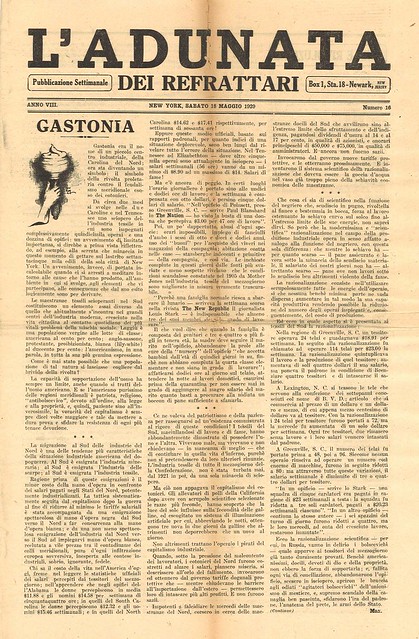
It was more than just an artistic expression but a mode of resistance. These poets were labourers who used words as weapons to shatter stereotypes, asserting their dignity as human beings. In this era, Italian immigrants faced racism, attacks, and even murder as they countered white supremacist narratives and became targets of some of the worst lynchings, including the New York lynching of Paulo Boleta in 1916 and the 1891 New Orleans lynchings. Italians were widely stereotyped as “WOPs” (Without Papers) and only seen as good for doing backbreaking labour, poetry provided the fuel to revive and hold onto the lost pride and to celebrate the roots of Italian-Americans (Deschamps, 2015).
The work of Italian-American poets was flowing, simple yet evocative, and created in English and/or Italian, making their works accessible to immigrant and American audiences. Therefore, their poetry acted as a double-sided blade: reminding Italian immigrants who they were while also revealing the struggles they faced as they adjusted to their new lives in American society (Sartarelli & D’Acierno, 1999). Giorgio Bertellini illustrates the creative practices and expressions connected to identity, providing Italian-Americans a means to navigate the cultural and racial ideologies of the machine called America (Bertellini, 2005).
Pascal D’Angelo
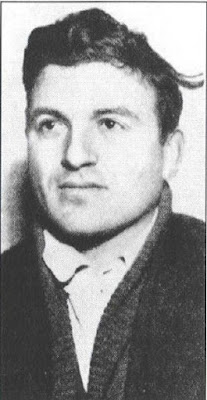
More specifically is the cornerstone, Pascal D’Angelo, who Van Doren “doesn’t call D’Angelo an Italian at all but ‘a typical example ‘of the peasants of his race’”. From a poor village in Abruzzo to the streets of New York, his life journey, one of resilience and creativity, is still studied by scholars, republished (Son of Italy published in 2003), and discussed by Italian literature Groups in New York and Introdacqua. D’Angelo. Even though he is one out of thousands of poets, Pascal held the ability to capture the stories of immigrants who held onto cultural pride as they struggled amidst hope for a new life. His work displays the greater struggle of the Italian-American community: making a new life while keeping themselves from losing their roots (Bencivenni, 2011). This strength to articulate the universality and complexity of immigrant life was seen exceptionally in his poem Mid-Dream.
“Am I a blossoming rose whose life is
fed on the hope of priding some
young beast?
Or do I dream like the rose
In my heart are echoes of young sighs”
- The Brooklyn Eagle, 1932
Yet the poetry of Italian-American labourers was more than the individual achievements, such as those of D’Angelo. It created and represented the voice of a group that shed light on the cultural and social challenges faced within Italian immigrant communities. As Ferdinando Alfonsi reveals in his Dictionary of Italian-American Poets, there are hundreds of these poets, each offering a different story, fighting for and writing on the American Dream (Alfonsi, 1989).
These poems display and, in a way, document the lives of these labourers in a way that no traditional historical record could. Letting readers experience and learn from this marginalized group’s emotions, aspirations, and struggles offers a new perspective on American history. They also preserve dialects, local Italian traditions, and personal memories, leaving an indelible mark on the cultural landscape (Cannato, 2015).
Italian-American immigration is a story of resilience, adaptation, and creativity. Immigrants such as Pascal D’Angelo worked through the trials of their new world, maintaining the richness of their heritage by way of hard work and poetry. The poetic output testifies with poignancy to art’s function of crystallizing cultural identity and encouraging group solidarity.
It is within the poetry of Italian-American labourers that historians gain a window into the role and complexity of immigration, labour, and tradition. The poems are not relics but the living history of the indomitable human spirit and how art reveals the complex world of immigrants. It is a legacy from Pascal D’Angelo and his generation, continuing to inspire and shape thinking on cultural resilience and the power of words.
References
Alfonsi, Ferdinando P. Dictionary of Italian American Poets. 1st ed. New York: Peter Lang Publishing Inc., 1989.
Baily, Samuel L. Immigrants in the Lands of Promise: Italians in Buenos Aires and New York City, 1870-1914. Ithaca, NY: Cornell University Press, 2016. https://doi.org/10.7591/9781501705021.
Bencivenni, Marcella. Italian Immigrant Radical Culture: The Idealism of the Sovversivi in the United States, 1890-1940. New York: New York University Press, 2011. https://doi.org/10.18574/nyu/9780814791035.001.0001.
Bertellini, Giorgio. “Duce/Divo: Masculinity, Racial Identity, and Politics among Italian Americans in 1920s New York City.” Journal of Urban History 31, no. 5 (July 1, 2005): 685–726. https://doi.org/10.1177/0096144205275981.
Cannato, Vincent J. “What Sets Italian Americans Off from Other Immigrants?” Humanities, 2015. https://www.neh.gov/humanities/2015/januaryfebruary/feature/what-sets-italian-americans-other-immigrants.
Deschamps, B. “‘The Cornerstone is Laid’: Italian American Memorial Building in New York City and Immigrants’ Right to the City at the Turn of the Twentieth Century.” European Journal of American Studies 10, no. 3 (2015). https://doi.org/10.4000/ejas.11299.
Mattalia, Giulia et al. “We Became Rich and We Lost Everything.” Human Ecology 49, no. 2 (2021): 217–24. https://doi.org/10.1007/s10745-020-00209-6.
Sartarelli, Stephen, and Pellegrino D’Acierno. The Italian American Heritage. New York: Routledge, 1999.