The Pick and Shovel Poet - Pascal D'Angelo
A Collection Built Around the Life of Pascal D'Angelo
Contents: Works | Analysis | References
D’Angelo’s Works
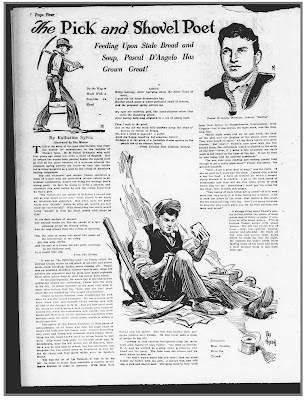
Pascal D’Angelo, through his autobiography and 25 published poems, illustrates the immigrant experience of the early twentieth century with a captivating and unique narrative of hardship, aspiration, and art (Barone et al., 2021, p. 11-13). His work reflects immigrant labourers’ struggles and the human spirit’s resilience. By analyzing his writings from his short works published in newspapers and other media to the close examination of his 1924 autobiography, Son of Italy. The works illustrate the struggle of D’Angelo between a life of manual labourer and literature, providing a unique perspective on a larger narrative of immigration and settling in America.
D’Angelo’s poetry appeared in major newspapers, like the afternoon daily newspaper Brooklyn Eagle, and other prominent publications, placing him alongside notable poets like Edna St. Vincent Millay and Rudyard Kipling (Barone et al., 2021, p. 25). “Many of these poems were reprinted in newspapers across the country and in Canada, frequently shortened and with altered lineation” (Barone et al., 2021, p. 15). His poems exposed the hard, bitter realities of immigrant life through powerful imagery, allowing a feel of the depth of the labourer’s trials and determination. An example of this is in his poem “The Toilers.”
“Brown faces of immatured senility
Twisted into an ecstasy of unshaped satiation.
Eyes that are huge, tumultuous flares of light
Peering athwart the forced austerity of tiredness.
Your hugely-muscled, stalwart arms
That lift the mammoth weight of majestic industry,
Branch up from your broad Herculean shoulders
In a magnificence of thronged power.
Reeling on the verge of eagerness
You shift about –
Throughout the night you are hurled
In a confused heave of struggling illusions,
Under the machinal flights of those moistened walls,
Under those black, moistened walls of disregarded futility.
Facing this Giant monument of bitterness –
Your thoughts!
Amid the incessant whirrs of the maniac motors,
Are smashed into fragments of an irresolved dream,
And you are swept on! On!
By the involuntary rapids of meniality
In the frenzied whirls of humiliation!
On! On!”
- The Literary Digest, 1922
The poem conveys the physical toll of the relentless work and the realization and humanization of broken dreams as immigrants became trapped in the labour structure of the time.
Of his most reflective poems, “Monte Majella” is typical of D’Angelo’s work in its weaving together of personal memory and universal themes.
“The mountain in a prayer of questioning heights
gazes upward at the dumb heavens,
And its inner anger is forever bursting forth
In twisting torrents.
Like little drops of dew trickling along the crevices
Of this giant questioner
I and my goats were returning toward the town
below.
But my thoughts were of a little glen where wild
roses grow
And cool springs bubble up into blue pools.
And the mountain was insisting for an answer from
the still heaven.”
- The Literary Review, 1922
It is a poem that depicts the immigrant longing for the lost beauty of his homeland, where cool springs bubbled up into blue pools. This imagery stands in contrast to the life he was living as an immigrant in America, depicting the immigrant’s dislocation and nostalgia for a lost way of life. By comparison, “The City” significantly denounces the dehumanization caused by the rise of the industrial world. D’Angelo writes about the “hecatombs of aching souls” and the “factory smoke” that engulfed the city, symbolizing the exploitation of workers’ lives.
However, it was not all dark, as D’Angelo also includes a signal of hope within this desperation as he states that these workers were “street lamps, like a million cups filled with light” (Barone et al., 2021, p. 19). This duality of despair and optimism is one of the most persistent themes throughout D’Angelo’s work, as his poetry contrasts his own personal struggles with his aspirations for a better life. A delicate balance between sharp critique and tame hope defines his work and allows the readers to gain a deeper understanding of the immigrant experience.
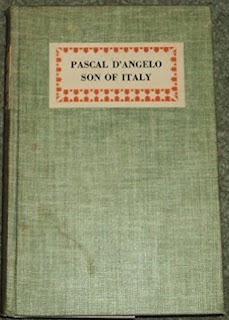
Son of Italy
Pascal D’Angelo’s 1924 memoir, Son of Italy, was a vividly detailed and very personal account of a life which progresses from a small mountain village in the Abruzzi region to the highly industrialized landscape of America. He describes his homeland as “soft green” valleys where “all the splendour of dawn burst” (Son of Italy, 1924, p. 160-162). These images of life and nature serve as a contrast to the gruesome realities he found as a labourer in the United States.
When he landed in America, D’Angelo was culturally disoriented. Revealing that he mistook the “Ave” on street signs for a word with religious meaning, showing readers the linguistic as well as cultural confusion (Son of Italy, 1924, p. 61). These moments of comic confusion illustrate the broader struggles of the immigrant to learn to live in a foreign environment without losing his cultural identity.
The book’s most notable passages are those related to the life of D’Angelo as a physical labourer. He remembers both the physical and emotional burdens of this job, characterizing it as a “chrysalis of forced ignorance” from which he longed to escape (Son of Italy, 1924). Despite these hardships, his artistic hopes and poetry gave him meaning and the power to move forward, writing, “If I write a good line of poetry, my work is not lost. It can be read by you today and by another tomorrow” (Son of Italy, 1924, p. xiii). These words reveal the power of art, both for his life but also the lives of immigrant labourers whose stories he attempted to bring to light.
Literary Influences
Pascal D’Angelo was an enthusiast of English romantic literature, through which he also discovered great classics of universal literature, such as Dante Alighieri’s Divine Comedy (Barone et al., 2021). Writing with sharp imagery, lyrical language, and emotional depth, he focuses on the contrasts of the agrarian-rural beauty of Italy against the harshness of industrial America with dynamic tension through his work. This may be seen most clearly in works such as “Midday,” where the serene childhood memories of Abruzzo are overrun by the oppressive heat and noise of the American workplace.
Furthermore, one of the strongest points in D’Angelo’s poetry is his work’s ability to universalize his immigrant experience. While his works are deeply rooted in specific Italian culture, their themes of displacement, struggle, resilience, and hope resonate with the broader immigrant audience. He was a unique voice as a labourer-turned-poet for both American and immigrant literature canons.
Works by D’Angelo were celebrated by literary figures during his lifetime, as Carl Van Doren described his poetry as a collective “authentic cry” of immigrants (Osservatorio Diaspora Italiana e Italofona, 2022). Along with this recognition, D’Angelo had been published in places such as The Nation and The Literary Digest and was able to secure for himself a place within the literature memory of his period. Despite his literary success, D’Angelo’s financial struggles persisted, thus dying in poverty in 1932 at the age of 38 with nothing but “two-feet of manuscripts and that several suitcases full of poems” (Barone et al., 2021, p. 13).
His memoir, Son of Italy, remains an inspiration and a landmark of works in the field of immigrant literature, providing a significant inside account of the trials and successes in the face of assimilation. Moreover, his poetry is considered a historical testament to the experiences of the immigrant worker, a tale of resilience and creativity from those who built America.
From the poignant poetry to his wrenching autobiography, the works of Pascal D’Angelo represent probably the most important probe into the immigrant experience. With his art, he transformed the struggles of labourers into a timeless cry of human dignity and hope. His narration of Labour, nostalgia and resilience gives unique and complex dimensions to the story of immigrant life in the early twentieth century. All in all, as a poet and storyteller, D’Angelo bridges the gap between the old world and the new, preserving the cultural heritage of Italian immigrants while also speaking for the universal experiences of immigrants.
References
Barone, Dennis, Siân Gibby, and Nicholas Grosso, eds. VIA: Pascal D’Angelo. New York: Bordighera Press, 2021.
D’Angelo, Pascal. Son of Italy. New York: Macmillan, 1924.
Osservatorio Diaspora Italiana e Italofona. “‘il Dio Di New York’: Fontanella Regala Una Seconda Vita a Pascal D’Angelo.” stradedorate.org, November 20, 2022. https://www.stradedorate.org/2021/05/24/il-dio-di-new-york-fontanella-regala-una-seconda-vita-a-pascal-dangelo/.
Newspapers used (for short poems): The Literary Review, The Liberator, The Century The Brooklyn Eagle, Shadows, The Literary Digest…