The Pick and Shovel Poet - Pascal D'Angelo
A Collection Built Around the Life of Pascal D'Angelo
Contents: Early Life | Life in America | References
Early Life
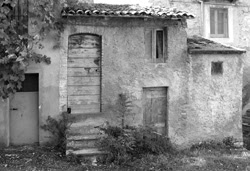
Born in Introdacqua, a small village confined in the mountains of the region Abruzzo, D’Angelo grew up facing the socio-economic struggles typical of southern Italy. Introdacqua suffered the same conditions that many villages faced in the South – poverty, underdevelopment, underemployment and corruption – as cities and towns in Northern Italy were fast becoming more industrialized. Poverty grew, and many Southerners held onto traditional practices of subsistence farming. This setting instilled in Pascal D’Angelo an appreciation of nature, a feature notably carried into his poetry.
By 16, Pascal D’Angelo emigrated to the United States with his father. Driven by the economic desperation he faced his whole life in Italy and the fascination of the New World of America. Coming to the US during this period of the early 20th century, he followed many southern Italian immigrants as a part of a great wave of mass migration pulled by the industrialization opportunity and the decline of the traditional agrarian practices in Italy. His journey proved to be a turning point in his life. D’Angelo moved away from the simplicity of mountain life to face the unforgiving demands of industrial labour and struggled altogether, as he found himself sleeping in trains before he could afford housing in New York City (D’Angelo, A., 2024, oral history). His autobiography, Son of Italy, published in 1924, follows this transition in his life, illustrating through words the psychological and physical toll that came from leaving his homeland (Son of Italy, 1924, p. 13–16).
Life in America
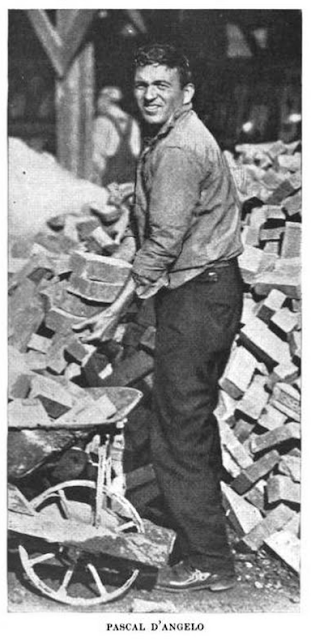
When D’Angelo and his father first came to America, they quickly drowned into the stereotypical pick-and-shovel labour, as he struggled to find a place outside of railroad construction or other similar grueling jobs. These labour roles became symbols of the limited options Italian immigrants quickly realized they faced, relegated to the bottom of the labour market. These oppressive conditions, along with Italy’s dive into World War One, pressured Pascal’s Father to return home and not look back to America. However, it also enabled D’Angelo to find inspiration to learn the English language, something quite uncommon for the “lowly” immigrant labourer. His determination to master English and write about his own experiences in poetry is what set him apart from most immigrant poets.
Pascal D’Angelo quickly got the nickname Pick-and-Shovel Poet, with his earliest published poem being “The Toilers“. His work depicted both the brutality and the unwavering dignity of the workers. It helped expose the conditions of immigrant labour to American literary readers who had no such first-hand experience. His poems became popular with other Italian immigrant and labourer readers as they resonated with and connected to D’Angelo’s work, quickly earning publication alongside giants such as Rudyard Kipling (Barone et al., 2021, p. 43). His work drew attention to the difficulties of immigrant labourers and revealed their strength and, most importantly, their humanity.
D’Angelo’s breakthrough came when his poem “The Railroad” was published in The Nation. He quickly gained recognition and was put into the spotlight, being praised for his work’s characteristics of vivid and heartfelt imagery of the immigrant experience. Furthermore, all his literary works and ambitions would culminate with Macmillan’s publication of his autobiography, Son of Italy, in 1924. This book is a mixture of prose and poetry, illustrating his life’s journey from enormous struggles through a life of labour to being a recognized poet (Son of Italy, 1924, p. ix- xi). Carl Van Doren, an influential literary critic and publisher, recognized D’Angelo’s work for its authenticity and artistic abilities. Van Doren advocated for more acknowledgment of D’Angelo and his art. Stating in the introduction of Son of Italy (1924) that “if this is not an authentic cry of pain, I have never heard one” (Osservatorio Diaspora Italiana e Italofona, 2022). His support quickly opened the doors to prestigious publishing houses and literary circles, helping solidify D’Angelo’s place in the cultural heritage of this time of immigration restriction (Barone, 2024, p. 4).
D’Angelo’s Poetry was a statement of his double identity as an Italian and an American. His work contrasts the rustic beauty of Abruzzo with the industrial brutality of America, coming together to create the story of the immigrant experience. His poems “Monte Majella” and “Midday” focus on the more pastoral peacefulness of his homeland, while others, like “The City,” depict the alienation and struggles of immigrant life in a loud and industrialized America (Barone et al., 2021, p. 16-19). Pascal D’Angelo’s use of lyrical language and vivid imagery allowed readers to become immersed in his works on the past, where they can almost touch the core of the emotion of his experiences. Thus, his poetry serves both as an important piece of personal expression and a historically significant broader commentary on the realities faced by immigrant communities in the early 20th century.
Beyond the literary work itself, D’Angelo was an important voice, a rising voice in the Italian immigrant community. His works provide insight and understanding of the cultural and social dynamics of an early 20th-century world, often ignored in common historical textbooks. Revealing the personal push and pull factors of the time and the struggles and resilience immigrants had as they fought to establish a new life and identity in a new land. Son of Italy stands as a testament of immigrant literature, one that gives historians the story of an immigrant with the transformative power of art to face the struggles of 20th-century industrialism. Through the documentation of his life and experiences, D’Angelo preserves his personal story and contributes to the collective memory of Italian immigrant labourers. His poetry also speaks to the great human spirit of the community, which, faced with a host of adversities, managed to leave an indelible mark on American society (Barone et al., 2021, p. 27).
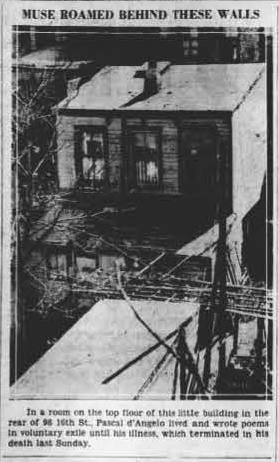
The life of D’Angelo was, like for most Italian immigrants, full of economic struggle and uncertainty, with few proper opportunities for economic growth or even stability. “By [1932] D’Angelo had pawned his typewriter and could not even afford paper. He continued to write, however, scrawling his poems in the margins of old newspapers, on the backs of calendars, and eventually on the walls of his apartment” (Anbinder, 2016, 388-9). D’Angelo faced psychological and physical stress during and after work. He died at age 38 on March 13, 1932 at Kings County Hospital from what reports state following an appendectomy and destitute. With no money even to pay for a funeral, he was buried in Brooklyn’s St. John’s Cemetery and for the most part forgotten.
Still, Pascal D’Angelo’s life and works embody the resilience, creativity, and determination of Italian immigrants in America. His life’s journey from labourer to well-known poet is a strong testimonial of how art and literature can change an individual’s life, even through deprivation and oppression. With his poetry and prose, D’Angelo gave a voice to many immigrants by putting their problems under light and celebrating their cultural identity. Post-death publications/re-publications and new scholarly interest in this era of mass immigration secured D’Angelo’s lasting legacy. His works are praised and studied as important contributions to immigrant and labour literature, revealing the lives, identity and artistic hopes of struggling immigrants of 20th-century America (Barone et al., 2021, p. 4). In reading and studying D’Angelo’s work, one can gain a deeper understanding of the intricacies of cultural resilience and adaptation that has defined immigrant communities’ hopes and perseverance.
References
Anbinder, Tyler. City of Dreams: The 400-Year Epic History of Immigrant New York. Boston: Houghton Mifflin Harcourt, 2016.
Barone, Dennis. Of Clouds and Mists: The Collected Poems of Pascal D’Angelo. Empyrean Series No. 44. Seattle: Sublunary Editions, 2024.
Barone, Dennis, Siân Gibby, and Nicholas Grosso, eds. VIA: Pascal D’Angelo. New York: Bordighera Press, 2021.
D’Angelo, Pascal. Son of Italy. New York: Macmillan, 1924.
Osservatorio Diaspora Italiana e Italofona. “‘il Dio Di New York’: Fontanella Regala Una Seconda Vita a Pascal D’Angelo.” stradedorate.org, November 20, 2022. https://www.stradedorate.org/2021/05/24/il-dio-di-new-york-fontanella-regala-una-seconda-vita-a-pascal-dangelo/.